Michael
Kensuke's KingdomMichael’s account of a childhood voyage becomes the story of how he was lost at sea, survived on a remote island, and formed a family-like bond with Kensuke Ogawa. Told retrospectively after a ten-year promise of silence has run its course, his narrative gives shape to both an extraordinary survival and the friendship he believes deserves to be remembered.
Identity and Retrospective Narration
Michael begins by identifying the date he disappeared: July 28, 1988, the night before his twelfth birthday. He explains that he is writing more than ten years later, after finishing school and college and having time to reflect. Kensuke had asked him to tell no one what had happened until at least ten years had passed; Michael kept that promise even though it meant living with a lie and deceiving his family and friends about his disappearance.
The decision to speak is not only about correcting that deception. Michael says he owes the truth to the people he misled, but gives greater importance to making the world know Kensuke as he knew him: a great and good man, and his friend. The retrospective account is therefore both a disclosure about Michael’s own survival and a tribute to someone who cannot tell the story himself.
The narrative’s documentary form is rooted in Michael’s childhood writing. On the Peggy Sue, he kept a personal account of the voyage, encouraged to write in it every few weeks. Though he had struggled with writing at school, he found he could speak his thoughts onto the page, and the old notebook still reads to him like his own voice. Its crinkled, yellowed pages preserve selected short entries from the journey, framing the later telling through the perspective of an eleven-year-old recording events as they happened.
The Voyage and the Loss at Sea
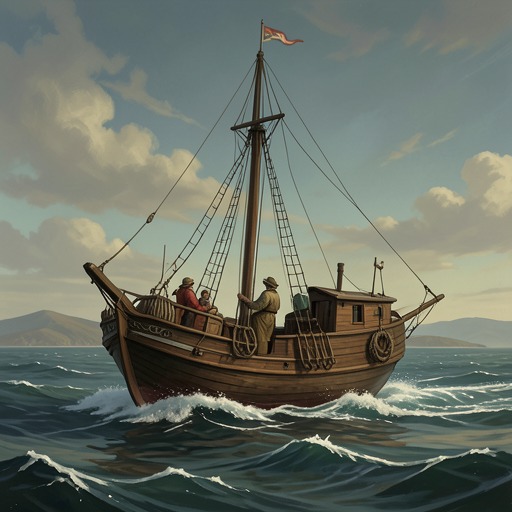
Michael sets sail with his parents on September 10, 1987, aboard the Peggy Sue, their boat for a planned voyage around the world. His mother is the skipper: she has mastered the books and charts and leads a family crew that Michael describes as a close, capable team. His father becomes his friend and shipmate, while Michael takes his place as the ship’s boy. Grandma and friends, including Barnacle Bill and Eddie Dodds, see them off. Eddie throws Michael a soccer ball as a lucky mascot, signing his name across it; the ball becomes an enduring link to home.
The log tracks the changing scale of the journey. On October 11, Michael sees Africa from a distance as the family travels down its west coast, planning to cross the Atlantic toward South America and taking care not to drift into the Doldrums. On April 3, off Perth, he reflects that the family has crossed empty ocean from Africa and reached Australia: halfway around the world, by their own effort. The excitement of landfall coexists with their pleasure in being alone at sea together.
That confidence is tested after the family leaves Sydney. Storms push the Peggy Sue north across the Coral Sea, the rudder cable snaps, and the self-steering fails. Michael and his father must take turns at the wheel while his mother’s recurring stomach cramps grow worse; she can manage only sugared water and has been unable to consult the charts for three days. She refuses to let his father send a Mayday, treating it as giving in. On July 28, Michael is at the wheel while his exhausted parents sleep below. He has Eddie’s ball with him and hopes his mother will recover, but admits that he and his father may no longer know where they are.
Michael goes overboard in the darkness while trying to bring Stella Artois back aboard. He reaches for what he thinks is Stella, but discovers that the white object beside him is the soccer ball; its buoyancy gives him something to cling to as the Peggy Sue’s lights vanish. He fears that no one can hear him and believes he has no hope of rescue. The ball that began as a farewell gift now helps keep him afloat, even as he has to stop searching for Stella and concentrate on surviving.
Stranded and Taken In
After reaching the island, Michael finds himself frightened, bewildered, and alone in a cave he begins to think of as home. He knows of only one other person there, an old man who has left him fish, bananas, and water but then banishes him to one end of the island after he lights a fire. Michael cannot reconcile that apparent kindness with the prohibition and separation. He suspects he is marooned with a madman, fears the mosquitoes and the animals in the forest, and sees attracting a passing ship as his only chance of escape.
Michael’s first impression of the old man changes through the account Kensuke later gives him. Kensuke had found Michael, Stella, and the ball at sea and brought them to safety, but he had wanted to remain alone. He left Michael food and water so that he would not die, then put out the fire and drew a line in the sand because he feared people would discover the island and harm its animals—or find and remove him. Michael had interpreted the prohibition as arbitrary hostility; Kensuke’s story reveals that it was also an attempt to protect the fragile refuge he had made.
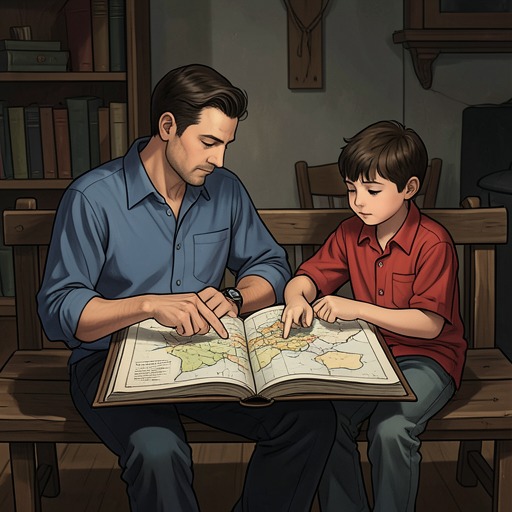
Their relationship develops through shared activities and a gradual exchange of life stories. As Kensuke learns English, the earlier silence between them gives way to conversation. One sunset, he asks Michael to tell his story from childhood onward. Michael recounts home, his parents, the closure of the brick factory, soccer with Eddie, and the family voyage, including the night he fell overboard. Kensuke recognizes Michael’s sadness and proposes that the next day they fish and he tell his own story. He frames their histories as potentially becoming one story.
Kensuke’s Story and Their Chosen Family
Kensuke tells Michael that he was born in Nagasaki, studied medicine in Tokyo, and later studied at Guy’s Hospital in London. Back in Nagasaki, he had a wife, Kimi, and a son, Michiya, and worked as a doctor caring for mothers and babies. During the war he served as a doctor aboard a Japanese warship. After American planes bombed the ship, he stayed with his patients; he survived while believing the other men aboard had died. Over the radio he then heard that an atomic bomb had fallen on Nagasaki. He believed Kimi, Michiya, his mother, and the rest of his family were dead.
Kensuke’s account explains his long isolation and his fear of other people. After the war, he lived alone on the island for many years. When armed hunters came, he hid the orangutans in his cave by singing to them, but the hunters killed gibbons and took their young. Kensuke became angry and concluded that people were killers; he wanted no one to find him again. This history makes Michael’s arrival a source of both care and conflict: Kensuke saves him, yet also fears that his presence will expose the island and its inhabitants.
The island has also become a place where Kensuke learned how to live. He watched what the orangutans ate and avoided, learned to climb as they did, and came to understand their warning signals. In time he built trust with them and became part of their community. Fishing and survival are not merely practical skills in his story; they are the means by which he has sustained himself in isolation and formed a bond beyond human company.
Kensuke explains that he was fishing for a large fish to smoke when the wind carried him far from shore. Frightened and unable to row back, he sang to make himself brave. Hearing a shout and seeing a light, he came toward Michael and Stella in the sea. He found Michael close to death and Stella in similar danger, then reached the island again with them. The person Michael had regarded as a strange, possibly hostile castaway was the person who had rescued him.
Kensuke eventually tells Michael that he thinks of him as a son and that Michael has become his family. Their bond is built after the initial mistrust, through conversation, fishing, painting, and the everyday work of living together. But the closeness sharpens the coming separation. Kensuke tells Michael that he does not want to return to Japan and has chosen to stay on the island, whereas Michael belongs with his family and wants to go home. Kensuke admits that he once hated Michael, then came to love him as a son, and says that he wants him to stay even though he knows that is not right for Michael.
Departure, Reunion, and the Story’s Meaning
Michael’s return to his parents does not erase the pain of leaving Kensuke. At the cave, Kensuke gives him the soccer ball and praises his painting, then walks with him outside and asks him to go. They bow to one another. Kensuke calls their acquaintance an honor, and Michael is too overwhelmed to reply. He runs down the track in tears; Stella catches up with him and barks at the Peggy Sue, which has arrived with Michael’s mother and father aboard.
Michael initially remains hidden in the trees as his parents call to Stella and drop anchor. He whispers goodbye to Kensuke, then runs onto the sand, waving and calling to the boat. In the shallows he meets his parents, and his mother embraces him and repeats that she had said they would find him. The reunion answers the family’s long search, but the farewell leaves Michael with a second home and a friendship he must keep through memory.
Michael’s account joins two journeys: the family’s voyage, which begins as a shared adventure around the world, and his own passage from being lost at sea to being welcomed into Kensuke’s life. The log entries preserve the changing physical route and the family’s changing fortunes; the later narrative revisits those events with knowledge the child recording them did not have. By finally telling the truth, Michael fulfills the delayed promise that shaped his silence and keeps faith with its purpose: Kensuke’s story, like the friendship between them, is not to be forgotten.